
30-03-2020

Redacción
Striped marlin, one of the most abundant billfishes

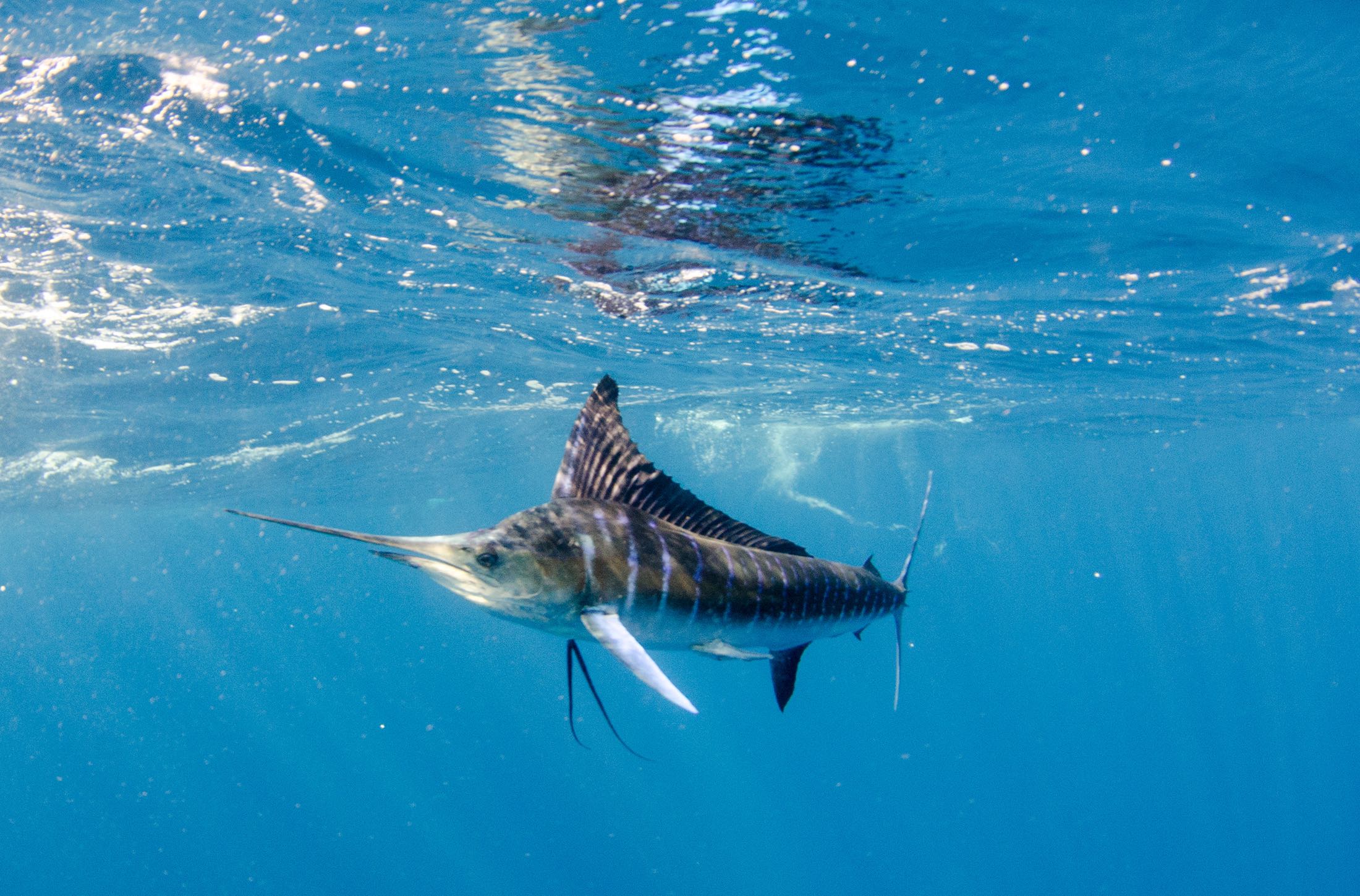
The striped marlin has an elongated, compressed body, whose upper jaw extends forward to form a medium-size, robust beak. A high and very pronounced first dorsal fin usually exceeds the height of its body. In specimens of large dimensions, this fin represents 90% of the length in horizontal body, the membrane of the first dorsal fin is blue, while the other fins are dark brown and sometimes dark blue. The anal fins are silvery white.
The pectoral fins are flat and can be easily folded to the body. The back of the marlin striped is dark blue, discreetly silver and both sides of the body have 18 to 22 vertical stripes. The flanks are blue-black above and white-silver below and the belly is white metallic. The lateral line is straight, simple and clearly visible. Most vertical lines are cobalt (pale blue). Usually swims alone, but at spawning time forms small groups. It feeds on fish such as mackerel, sardines, anchovies, crustaceans and squid. For its growth it needs colder waters than blue and black marlin.
According to recent studies, striped marlin spend 86% of their time swimming on the surface during the spawning season. Each fertile female can lay between 11 and 29 million eggs. These eggs are spherical with a diameter of between 1-1.5 millimetres, transparent and resembling a simple drop of oil. Fertilization is external.
The spawning season appears in May-June in the Northern Hemisphere, coinciding with the time of the beginning of summer, and in the Southern Hemisphere, in the months of November-December and beginning of the austral summer.
Thanks to the TAG-and-recapture it has been demonstrated that the striped marlin is a great migrator, with specimens that have moved from Baja California to Hawaii, Peru, the Marquesas Islands, etc.
The striped is the most acrobatic of the marlins, and is very easy to capture. When he has bitten and feels trapped, he can calmly perform between 10 and 12 jumps out of the water for the purpose of escaping. It is possible to fish with artificial bait or with natural bait, either alive or dead (tuna, dorados, mackarel).
It covers about 30-31 miles a day and can cover long distances of up to 3,000-3,500 million. In recent years the striped population has decreased significantly due to the increase in catches, both commercial and sporting, which is why many organizations are working in the direction of creating protection zones for billfish and insisting on catch and release. Hence the insistence on fishing with artificial bait and circular hooks, which do not damage the specimen. This billfish is found mainly in the Indian and Pacific Oceans, although some specimens have been caught on the west coast of Africa at the height of the Cape of Good Hope. Located in tropical and temperate waters ranging from 180 to 300 degrees, it is a pelagic and migratory fish, which moves in the open ocean along the continental shelf. It is accustomed to approach the coast, with hot currents or pursues banks or schools of sardines or squid. It usually goes towards the equator in the cold season and moves away from it at the beginning of the hot season.
Highest concentrations in the Pacific Ocean are in the northwest (Japan, Philippines, etc.); east (western California Peninsula, Baja California, Mexico Coast, Central America, Colombia, Ecuador and Peru); southwest (South Australia, Tasmania and New Zealand). In the Indian Ocean, the highest concentrations occur in Africa: Kenya, Tanzania, Mozambique and Zanzibar). And in the West Arabian Sea, Bay of Bengal and northwest coast of Australia.

The world record was achieved in Tutukaka (New Zealand) on January 16, 1986 with a piece of 494 pounds. It is estimated that the maximum weight can reach 550 pounds, although it seems that a specimen of 440 kilos was caught professionally.


23-01-2020

Dr. Ruperto Oliveró


23-01-2020

Dr. Ruperto Oliveró
The best hot spots for sailfish

The color of the sailfish livery depends on the level of excitement of the fish but is generally dark blue on the back, blue brown on both flanks and silvery white below the belly. It has a single lateral line on the flanks, along the entire body, which is very evident and is situated above the pectoral fins and extends to the base of the tail. On the body flanks it has a series of vertical blue-grey lines with some spots. It has a rigid crescent-shaped tail and a very powerful caudal peduncle that allows it to swim fast.

Its upper jaw is elongated beak-shaped and circular in appearance, has two dorsal and two anal fins. The first dorsal fin is large and elongated sail-shaped, retractable and the size is twice as wide as that of the animal's body. This dorsal fin, slate or cobalt blue, consists of 37 to 40 vertical stripes with black spots on the Atlantic sailfish, while on Indo Pacific specimens, the number of stripes appears to be somewhat less.
>br> The second dorsal fin is very small with 6-8 stripes. The pectoral fins fold along the body. Pelvic fins are very thin but very long. It is the fastest fish in the sea and can reach speeds of up to 109 km/h, thanks to its hemodynamic and muscular body. It can measure up to three meters and usually feeds on octopuses, squids and small fish (sardines, anchovies, small tunas ...). It looks for food in intermediate waters or near the surface.
>br> Sailfish can be found in tropical and subtropical waters throughout the oceans and in the vicinity of continental masses. Normally found at depths of more than ten metres, it travels alone or in small groups of three or four. In the first year of life it can weigh up to 30 kilos and its average life span is ten years. The eggs of the female are covered by two or three males and the laying of eggs occurs throughout the year, but especially in the summer period.

The fishing methods are trolling with artificial bait, with natural dead bait (ballyhoo) or with live bait. Often a combination of octopus or artificial squid with strips of tuna belly or ballyhoo is used.


23-01-2020

Dr. Ruperto Oliveró
Spearfishes, the other billfishes

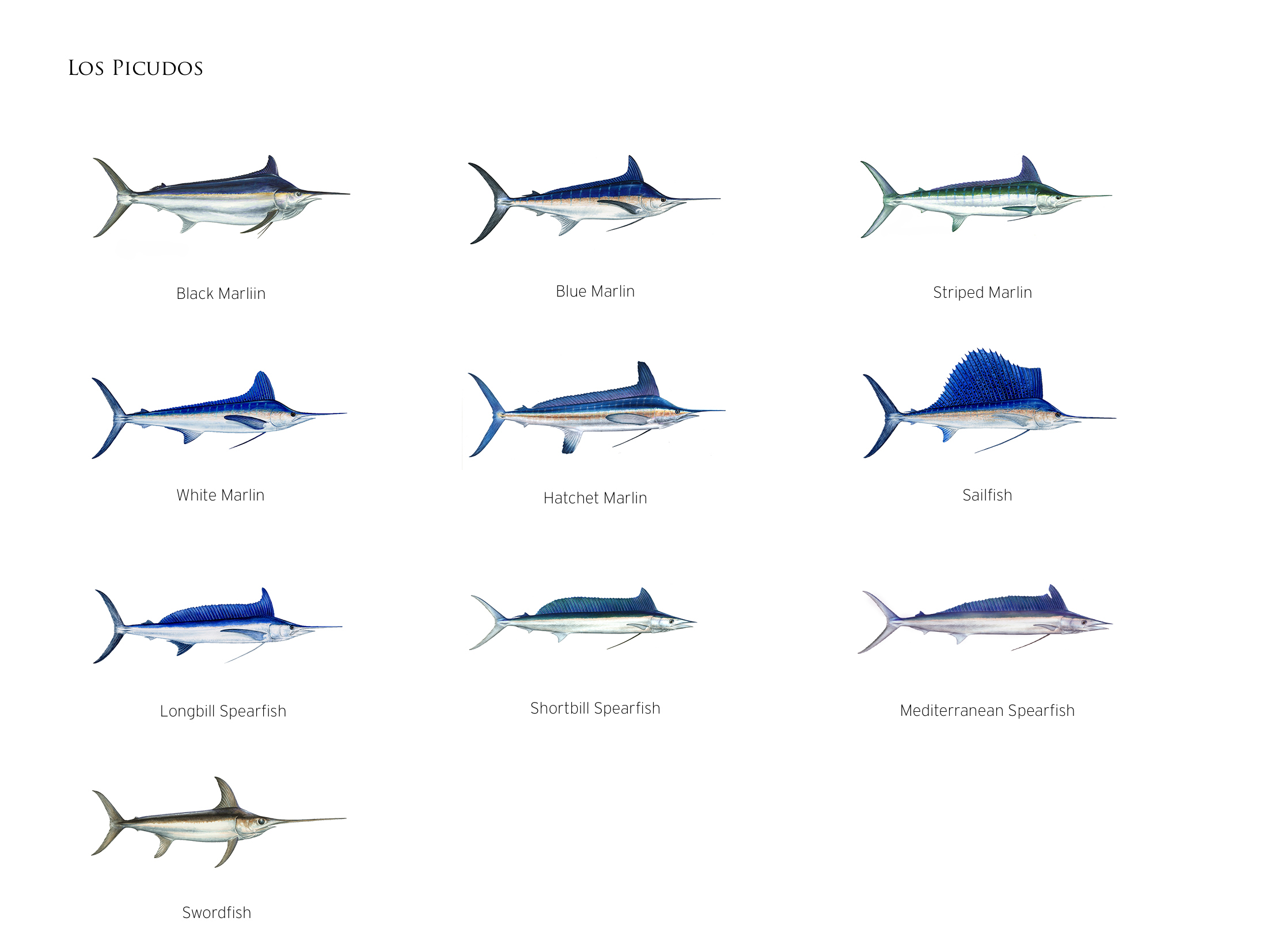
Within the spearfish family, of the genus Istiophoridae, we can distinguish four types: tetrapturus pluegeri: longbill spearfish (long sword), tetrapturus angustirotris: shortbill spearfish (short sword), tetrapturus belone, Mediterranean spearfish, also called aguja imperial and tetrapturus georgii: roundscale spearfish.
The first, dark blue body, silver, white underneath and a well deployed dorsal fin, with an upper jaw that extends into the shape of a beak or sword, is found in deep water, feeds on the surface on small fish, medium, squid, flying fish, etc..
They are found mainly throughout the Atlantic Ocean, from the coasts of the United States and New Jersey, to the Gulf of Mexico, the Caribbean, Venezuela and the eastern Atlantic, the coasts of Portugal. Algarve, Gulf of Cadiz and Canary Islands.
It can sometimes be mistaken for white marlin. Sometimes specimens have been caught on the west coast of South Africa, around the Cape of Good Hope, but it is very unusual. Some experts report the capture of long bill spearfish off the coast of Richards Bay (South Africa) in the Indian Ocean.
The short bill spearfish, with a very short upper jaw or beak and a shorter lower jaw than the upper one, is dark blue in colour, has an elongated and fairly compressed body, a white and silvery ventral area and a very dark blue dorsal fin, is found in deep water, eats at the surface and feeds on small fish, cephalopods and crustaceans. This variety of spearfish does not exceed 2.50 m and rarely weighs more than 55 kg. It is mainly found in the Pacific and Indian Oceans, Hawaii, Australia (northeast and northwest coast), New Zealand, mainly in the Plenty Bay area between Waihau Bay and Mercury Bay, and also in French Polynesia
The females are usually larger and the world record was set by an Australian fisherman with a 50kg specimen in Botany Bay (Sydney) in 2008. Rarely has a specimen been caught in the southeastern Atlantic Ocean.


23-01-2020

Redacción
ALL ABOUT BLUE MARLIN

We can identify two types of blue marlin, the Atlantic and the Pacific. Both are very similar, the only difference lies in size. The largest, it seems, are in the Pacific Ocean. On the other hand, IGFA -International Game Fish Association- considers that it is the same, although it takes into account the world records of the two blue marlin categories, the Pacific and the Atlantic. Those from the Indian Ocean are classified in the Pacific category. Blue marlin is the least abundant of all marlins and is not always easy to find, especially in the Pacific

In general, blue marlin that are fished out of season are less numerous, but often of larger sizes. For example, in Mauritius, in the month of August they approach 1000 pounds and, in Hawaii, one of 1656 pounds was caught in March 1984.

PACIFIC BLUE MARLIN
Generally found in the warm waters of the equatorial regions, moving away from the equator in summer and returning in winter. Apparently, its migration depends more on temperature than with black marlins. In order to live they need depth, that is why it is not easy to find them near the coasts except in places like Hawaii or Canary Islands, where very near the coast there are great depths that allow them to swim comfortably.

Longliners have sometimes caught 2,000 pound marlins, but the largest caught in sport fishing weighed 1,805 pounds in Hawaii, although it was not certified by IGFA, as it was not caught by a single fisherman, but by several who took turns in combat.
Marlins over 300 pounds are usually females. The blue marlin feeds on skipjacks, bigeye and yellowfin tuna, all of which can reach up to 150 pounds, so it is common to find them swimming among the tuna banks. Blue marlin feed both in depth and on the surface and sometimes small swordfish have been found in their stomachs. The first blue marlin caught with a rod and reel weighed 1040 pounds and was caught by the famous writer Zane Grey.


When to get blue marlin in the Pacific:

  • Australia, in January.
  • Costa Rica, in June and July.
  • Islas Carolinas,, in September and October.
  • Colombia, en Februar and Marzo.
  • Ecuador, in Octuber and Noviembre.
  • Hawai, in July, August and September.
  • Kenia (Shimoni), from December to March.
  • Mauricio, from December to March.
  • Baja California, from Octubre to December.
  • Mozambique, from August to December.
  • Nueva Zelanda, in February and March.
  • Filipinas, in June and July.
  • Réunion, from December to March.
  • Panamá, from January to April.
  • Seychelles, from October to Decembre and from May to June.
  • Tahití, from January to April.
ATLANTIC BLUE MARLIN
Like the Pacific, the blue marlin of the Atlantic also prefers warm waters that do not exceed 30 º C. They are found in the deep waters of the Virgin Islands, Bahamas, Gulf of Mexico, Caribbean Sea and West African Coast off the Gulf of Guinea.

The best concentrations are found in the northern part of Cuba and the western edge of the Bahamas Islands, smaller in proportion to the blue marlin of the Pacific, its average weight ranges between 300 and 400 pounds, although sometimes can exceed 1000 pounds. Some fishermen certify to have seen them weighing 1500 pounds; the largest are found on the longest migratory routes such as Venezuela, Brazil and the west coast of Africa.

The average weight of marlins caught in the Gulf of Guinea (Abidjan) is around 600 pounds, almost double the overall average. They generally do not move in schools, but in the mating season they go in pairs, male and female. Their migration can be very long, the best known is that of the Virgin Islands to the Gulf of Guinea, crossing the entire Atlantic, turning around during the same year. This could be demonstrated thanks to the tagging of the fish.

It is believed that they reproduce throughout the year, but no study so far can confirm it. Mating occurs in July and August in Puerto Rico; the Virgin Islands would be a meeting place before migration begins; in the Gulf of Mexico mating is in July and August and both Brazil and Bermuda are also mating areas. On the islands of Sao Tome and Principe, opposite Gabon - in the middle of the Gulf of Guinea - is another mating area and they would possibly stay longer than estimated, to release the eggs.

Fishing months:
  • Ivory Coast (Abdijan): Noviembre, diciembre, abril y mayo.
  • Guadalupe: September to April.
  • Bahamas (Bimini, Cat Cay, Walker’s Cay, Club Lay): From May to August.
  • Bermuda: From July to September.
  • Brasil: November to February.
  • Canary Islands: July to August.
  • Cayman Islands: May to June.
  • Cuba: May to October
  • Dakar (Senega)l: From May to October.
  • Gulf of Mexico: June to October.
  • Gabon: January and February.
  • Jamaica: September to October.
  • Madeira: From July to September.
  • Azores: August and September.
  • Puerto Rico: September and October.
  • North Carolina: From June to August.
  • Virginia: July and August.
  • Venezuela: August to June.
  • Virgin Islands: From July to September.


23-01-2020

Redacción
Top 10 hot spots for white marlin

The white marlin, whose scientific name is Tetrapturus Albidus, is the smallest of the Istiophoridae family (Fish with sword). It can weigh up to 200 pounds. Its world record is a specimen of 181 pounds (82.5 Kilos) caught in Victoria, Brazil, on December 8, 1979 by fisherman Evandro Coser, with a line of 30 pounds.

With a straight jaw, the pectoral fins bend along the body and have a rounded shape. The dorsal fin is retractable. The tips of the pectoral fins, the first dorsal fin and the first anal fin are rounded rather than pointed, although this characteristic may vary in some specimens where the pectoral fins may be more pointed and the anal fins more rounded than others.

Its first dorsal fin is very similar to the stripped marlin and is as high or higher than the rest of the body, but both edges are convex. The pectoral fins are mobile and flat and are fully retracted against the body and the lateral line is noticeably visible and curves above the pectoral fin and follows a straight line to the base of the tail.

White marlin is lighter in colour and tends to be greener than other marlins. The body is dark blue-to-chocolate brownin colour, which may change to silvery white under the belly. Several light blue vertical stripes can be seen on their flanks especially when the fish is jumping out of the water. Some specimens may have black or purple spots on the first dorsal and anal fin.

White marlin mature sexually at a weight of 40-45 pounds. Females, which are bigger than males, can live up to 25-30 years, and produce significantly more eggs as they increase in size. In some places the spearfish (Hatchet Marlin) (Tetrapturus sp) is considered to be a variant of white marlin.


20-01-2020

Dr. Ruperto Oliveró


05-05-2019

Redacción


28-02-2019

Redacción


THE CLUB. Register here
TERMS AND CONDITIONS
CONTACT US
COOKIES POLICY
NEWSLETTER
I wish to receive the monthly newsletter: